Future-Proofing Your Website: What Actually Matters
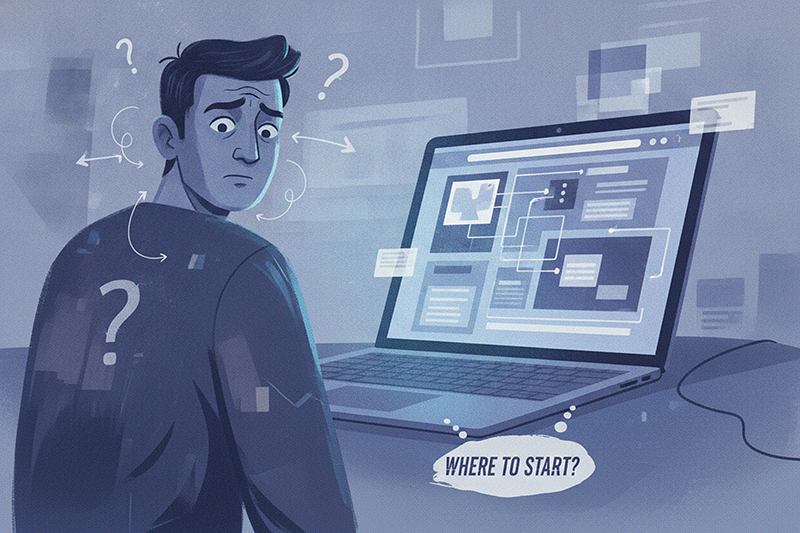
Your website still loads. The contact form still works. Nobody’s complained in months. That’s exactly the problem.
A site can run perfectly fine on the surface while quietly losing ground underneath: slipping down search results, feeling clunky on a phone, falling behind competitors who redesigned two years after you did. Nothing breaks. Nothing crashes. It just gets quieter, one search result at a time.
We work with Irish businesses at exactly this stage. Not the ones whose site is broken, but the ones whose site is ageing without anyone noticing until enquiries start to dry up. So let’s talk about what it actually takes to future proof your website and why that’s a different question from “does it still work.”
Why “It Still Works” Isn’t the Same as Future-Proof
A website built five or six years ago was likely built for a different internet. Search engines have changed how they read pages. Visitors browse on different devices, at different speeds, with different expectations of how fast something should load.
None of that shows up as an error message. It shows up as a website losing rankings slowly enough that you don’t clock it until a competitor overtakes you in search results for the exact phrase your customers use to find you.
Future proofing isn’t about chasing every new trend. It’s about building (and maintaining) a site on foundations that don’t need tearing up every time something shifts. Think of it less like buying a car and more like maintaining a house: the roof doesn’t fail overnight; it fails because nobody checked it for a decade.
The Technical Foundation That Actually Ages Well
Some decisions made at the build stage determine how much work (and money) you’ll need to sink in later. Two matters more than most.
Website scalability. Can your site handle more products, more pages, and more traffic without a rebuild? A site built to add one service page might buckle when you need fifty. We’ve seen businesses hit a wall simply because their original structure never accounted for growth: adding a new product category meant rebuilding navigation from scratch instead of slotting it in.
Responsive web design. This isn’t a checkbox anymore; it’s the baseline. A responsive site adjusts to the screen it’s viewed on, whether that’s a laptop, a tablet, or a phone with two bars of signal on a train. If your site was built “for desktop, with a mobile version bolted on,” that gap will show. And it shows exactly where it costs you most: at the point someone’s ready to get in touch.
A quick gut check: open your own site on your phone right now. Does the menu work with one thumb? Does the text need pinching to read? If you’re hesitating before you even try, that’s your answer.
Search Visibility Isn’t a One-Time Setup
Here’s something worth saying plainly: SEO (search engine optimisation, the practice of helping your site appear higher in search results) isn’t a task you finish. It’s closer to plumbing than paintwork. You maintain it, or it degrades.
An SEO friendly website in 2026 needs:
- Clean, fast-loading code that doesn’t force a visitor to wait
- Content structured with clear headings that both people and search engines can scan
- Pages that answer the actual question someone typed, not just the topic in general
- Internal links that guide a visitor (and a search engine) logically from one page to the next
Search engines increasingly favour pages that give a direct, useful answer early, rather than pages that dance around a topic for three paragraphs before saying anything concrete. That’s not a stylistic preference. It’s a structural one, and it’s one of the more overlooked reasons a previously well-ranking page starts sliding.
If your site was optimised once, at launch, and never revisited, that’s usually where the slide begins. Not because anything broke. Because search kept moving and the page stood still.
Accessibility Is Part of Future-Proofing, Not an Extra
Website accessibility means making sure your site works for people using screen readers, people navigating by keyboard rather than mouse, and people with visual or motor differences that affect how they browse.
It’s often treated as a nice-to-have, bolted on if there’s budget left over. That’s backwards. Accessible design tends to be better design, full stop: clearer contrast, more logical navigation, and simpler forms. What helps a screen reader user also helps someone squinting at their phone in bright sunlight.
There’s a legal dimension too, particularly for businesses trading across the EU (European Union), where accessibility requirements have been tightening. We won’t guess at specifics that depend on your sector or size here; that’s worth checking against your own legal advice. But from a purely practical standpoint, building accessibly now costs far less than retrofitting it later.
What Website Modernisation Actually Looks Like in Practice
Website modernisation doesn’t always mean starting from zero. Sometimes it does. More often, it means identifying which parts of a site are structurally sound and which parts are quietly working against you.
Signs it’s time to look seriously at modernising:
- Your site takes noticeably longer to load than it used to, without you having changed anything
- You’re manually editing code to add basic content because there’s no proper system behind it
- Your bounce rate (the share of visitors who leave after one page) has crept up with no obvious cause
- Competitors’ sites feel faster, clearer, and easier to use than yours, even if you can’t say exactly why
None of these mean panic. They mean it’s worth an honest look at what’s underneath the surface, rather than another six months of hoping it settles itself.
Choosing a Web Design Agency That Builds for the Next Five Years, Not Just Launch Day
Here’s an insider detail worth knowing: many website quotes are priced around launch day, not the years after it. That’s how a site ends up needing a full rebuild after three years instead of a series of small updates.
At Flo Web Design, we’ve built and maintained Irish business websites for over 24 years, from our offices in Drogheda, Kells, and Dublin. That length of time teaches you which decisions save money later.
When you’re choosing a web design agency, ask less about how a site looks on day one and more about how it copes in year three. Modern website design isn’t just current styling; it’s a structure that bends as your business grows, rather than cracking under the weight of change. That’s the real difference.
- Ask how they handle updates and scaling after year one, not just at launch
- Look for real examples of sites they’ve maintained for several years, not just recent launches
- Check whether SEO and accessibility are built in from day one, not added later as an afterthought
Not sure if your site is built to last? Talk to our team about a straightforward, no-pressure review of where it stands today, and what’s worth improving first. We’ll tell you honestly, no upselling.
Frequently Asked Questions
What does it mean to future-proof a website?
It means building your site so it adapts to search changes, new devices, and growth without needing a full rebuild every few years.
How often should a business website be updated?
There’s no fixed rule, but most sites benefit from a technical and content review at least once a year to catch slippage early.
Why is my website losing rankings even though nothing changed?
Search engines update constantly. A site left untouched can slip simply because competitors and search standards move forward while it stays still.
Is responsive web design still necessary by 2026?
Yes. Most website visits now happen on mobile devices, so a site that isn’t fully responsive loses visitors before they even reach your content.
What’s the difference between a redesign and website upgrade?
A redesign often starts from scratch. Modernisation improves the working parts of your existing site while fixing what’s genuinely outdated.
Does website accessibility affect SEO?
Often, yes. Accessible sites tend to have cleaner structure and clearer navigation, both of which search engines also reward.
How do I know if my website needs scalability improvements?
If adding a new page, product, or service feels harder than it should, your site’s structure likely wasn’t built to grow with you.
What should I look for in a web design agency?
Ask how they build for the years after launch, not just the launch itself. Long-term thinking matters more than initial appearance.
Can an older website still rank well in search?
Yes, if it’s properly maintained. Age isn’t the problem; neglect is. Regular technical and content upkeep matters more than launch date.
How much does website modernisation typically cost?
It depends entirely on your site’s current state and goals, so we’d always recommend a proper assessment before estimating anything.