AI, Automation and Your Website: What Irish Businesses Actually Need to Know
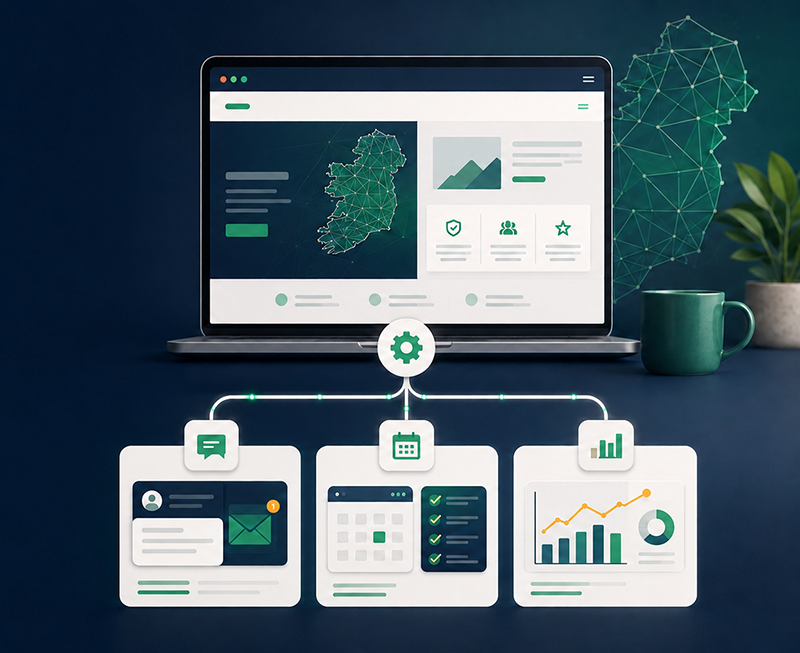
Many Irish business websites lose enquiries every single day, not because the business did anything wrong, but because nobody was there to answer at the exact moment someone was ready to ask. A question comes in outside office hours, gets no response, and the person moves on to whoever answers first.
That gap, between “someone’s interested” and “someone got a reply”, is exactly what AI and automation were built to close.
What “AI on your website” actually means in 2026
Two different things get lumped together under this heading, and mixing them up leads to bad decisions.
AI website tools use artificial intelligence to make judgment calls. Think of a chatbot that reads a visitor’s question and works out how to answer it, or a system that quietly reorders your homepage based on what a visitor seems interested in.
Website automation is simpler. It follows fixed rules to do repetitive jobs without a person lifting a finger: sending a booking confirmation, alerting you to a new enquiry, or moving a form submission into your inbox.
Most small businesses don’t need the first one straight away. Nearly all of them would benefit from the second.
The tools that are actually worth it for Irish small businesses
However, not every fancy AI feature belongs on your site. These are the ones that consistently earn their place.
AI chatbots and website lead generation
An AI chatbot for your website answers the questions people ask at 9pm, on a Sunday, or during your lunch break. It won’t close a complex sale. What it will do is capture a name, a number, and a reason for getting in touch, so nobody vanishes into the dark simply because you weren’t online.
The honest limitation: a chatbot is only as good as the information behind it. Point one at a thin, outdated site and it’ll frustrate people faster than no chatbot at all.
Automated booking, follow-up, and enquiry handling
This is the quiet workhorse of website automation. A tradesperson gets an automatic text the moment someone requests a callback. A clinic sends its own appointment reminders. A shop confirms an order without anyone typing a word.
None of this needs to be clever. It just needs to run reliably while you’re doing the actual work of running your business.
Personalisation and website user experience
Some AI tools adjust what a visitor sees based on how they arrived, what device they’re using, or what they’ve already looked at. Done well, this genuinely improves website user experience: fewer dead ends, faster answers, less scrolling to find the one thing someone actually wants.
Done badly, it feels invasive. The line between the two is thinner than most vendors admit.
What AI can’t fix (and what to sort first)
Here’s the thing nobody selling automation tools wants to tell you: bolting AI onto a slow, cluttered, badly structured website doesn’t fix the website. It just makes the same problems happen faster.
We’ve built websites for Irish businesses for over 24 years, and the pattern repeats constantly. A business adds a chatbot to compensate for a confusing site, and visitors get frustrated twice over: once by the navigation, then again by a bot that can’t answer questions because the underlying content never explained the service properly in the first place.
Before adding anything AI-branded, ask honestly:
- Does the site load quickly on a phone with a weak signal?
- Can a first-time visitor find your pricing, services, or contact details in two clicks?
- Is the actual content on each page clear enough that a human, never mind a bot, could answer a question from it?
If the answer to any of those is no, that’s where website optimisation services earn their money first. Automation amplifies whatever’s already there. It doesn’t replace good web design in Ireland, and it never will.
AI, Google, and getting found
Search itself has changed shape. Google’s AI Overviews now answer plenty of questions directly on the results page before anyone clicks through to a website at all. For an Irish business, that shift matters more than most AI headlines combined.
It means your website’s job is no longer just to rank. It’s to be worth extracting: content clear enough, specific enough, and well-structured enough that both a human and a search engine’s AI can lift a straight answer from it without confusion.
That’s less about chasing every new AI trend and more about doing the fundamentals properly: answering real questions in plain language, structuring pages so the important information isn’t buried, and keeping content current instead of publishing it once and forgetting it. That’s the quieter, less glamorous side of digital transformation in Ireland, and it matters more than any single tool you add.
Getting this right also depends on the parts of your online presence people don’t think about until something breaks: reliable IT support keeping everything running and website support packages that mean updates happen before they become problems.
A simple way to decide if you’re ready
You don’t need to overhaul everything at once. Work through this instead:
- Count your after-hours enquiries. If people are messaging or emailing outside your working hours regularly, a chatbot or automated response earns its keep fast.
- List your repetitive admin tasks. Booking confirmations, follow-up emails, order updates: anything you do the same way every time is an automation candidate.
- Check your site’s foundations. Speed, mobile usability, and clear content come before any AI layer, not after.
- Ask what a visitor actually wants to know. If you can’t answer that in one sentence, no AI tool will fix the gap for you.
- Start with one thing. Business automation services work best added one at a time, tested, then built on, not switched on all at once.
If you’re a small, local operation with low enquiry volume, you may genuinely need very little of this yet. And that’s a fair answer too.
Where to go from here
AI in web design isn’t a switch you flip. It’s a set of decisions, each one only worth making if it solves a real problem you actually have. Get the fundamentals of your bespoke website design right first, then add the automation that genuinely fits your business, not the version a vendor is trying to sell you this month.
If you’re not sure where your own site sits on that list, that’s a conversation worth having before you spend a cent on anything AI-branded.
Frequently Asked Question
- What is website automation, and how does it help small Irish businesses?
Website automation handles repetitive jobs automatically, like replying to enquiries, booking calls or sending follow-up emails, so your site keeps working after you’ve closed. It’s one form of AI for small businesses. - Do I need an AI chatbot for my website?
Not every business does. An AI chatbot for your website helps if you get repeated enquiries outside office hours. If enquiries are already low volume, simpler tools may serve you just as well. - What’s the difference between AI website tools and website automation?
AI website tools use artificial intelligence to make decisions, like personalising content. Automation follows set rules to complete repetitive tasks, such as sending a booking confirmation. - How can AI improve my website’s user experience?
AI can personalise content, suggest relevant pages and answer visitor questions instantly. This improves website user experience and cuts the frustration of hunting for information. - Is digital transformation expensive for small businesses in Ireland?
It doesn’t have to be. Digital transformation in Ireland can start small, with a booking tool here and an automated email there, and grow as your budget and needs allow. - Can AI actually help with website lead generation?
Yes. AI chatbots and smart contact forms can qualify visitors, answer common questions and capture contact details automatically, turning casual browsers into genuine enquiries. - How do I know if my website needs optimisation services?
If visitors leave quickly, enquiries are low, or you’re manually answering the same questions daily, that’s a sign your website could benefit from optimisation services. - What should Irish businesses look for in AI in web design?
Look for a partner who explains AI in web design in plain English and builds around your actual customers. At Flo Web Design, we only add automation when it genuinely helps. - Is my website ready for business automation services?
If your website is fast, mobile-friendly and well-structured, it’s ready for automation. If it’s outdated, slow or hard to navigate, sort out that groundwork first.